Saturday, May 10, 2014

CBS - PRE MIGRATION ACTIVITIES

CBS - PRE MIGRATION ACTIVITIES

Written By Admin on May 9, 2014 | Friday, May 09, 2014


CORE BANKING SOLUTION
(PRE MIGRATION ACTIVITIES)


Core Banking Solution (CBS) is a network of post offices, which enables customers to operate their accounts and avail account related services from any post office. It replaces the existing sanchay post. The difference between sanchay and CBS is very simple. Sanchay Post is a LAN (Local Area Network) based application. CBS on the other hand is a centralized application with internet base.


CBS will make the job stress free as there will not be any possibility of data manipulation at any stage. There will be master data for each customer with a unique customer id. This will also link one account with all other accounts.

In the first phase, the core banking solution with finacle software will be implemented in all Head Post offices. All savings data ie SB, RD, NSC, KVP, MIS, TD, PPF along with all discontinued schemes, should be updated in sanchay post or in the tool supplied by the department.

As the modification is very difficult and risky job in finacle, all postmasters should see that the information should be fed with accuracy. The following are some important tasks to be completed immediately before migration to make the CBS success.

CERTIFICATES
Segregate all live applications from the binder and file the same in separate binders (say 200 or 300 for each) and allot serial no to the all binders.
Handover the binders to the infoysis vendors one by one.
Check the feeding cent percent and put a remark CHECKED on the binder.
Settle all discrepancies, if any, on the end of the day itself with top most priority as it is almost all impossible after migration.
A register with binderwise and with the columns date, type, binder no, appln from-to, total no of applns, no of applns completed, no of applns due in the binder, remarks should also be maintained daily.

DATABASE ANALYZER
Install and run latest DB Analyzer ie DBA+ and settle all discrepancies immediately.
Install and run latest DET and settle all discrepancies immediately.
A register with columns date, type, nature of discrepancy, total No, settled today, balance due, remarks.

PASSBOOKS VERIFICATION
Call for all SB passbooks ie SB/RD/TD/PPF etc through SB 46 notices and verify the same with the PB Vfn Tool.
Settle all discrepancies immediately by checking with original vouchers.
Verify all closed TD accounts, which may likely be shown as live in sanchay module.
A register with columns date, type, total no of passbooks existing, passbooks reced for vfn, verified, balance, remarks.

MISCELLANEOUS
Clear all minus balances immediately and maintain a register with columns date, OB, raised today, total, cleared today, balance, remarks.
Clear all SBCO Objections immediately and maintain a register with columns date, OB, raised today, total, cleared today, balance, remarks.
Complete labeling of all silent accounts immediately.
Open savings accounts to each MPKBY and SAS agents and upload the same with sanchay module.
Verify SB-63 and SB-85 registers and see that the same may be updated

Tips for managers: How to inspire your team members

Tips for managers: How to inspire your team members

Written By Admin on May 9, 2014 | Friday, May 09, 2014

At a time when an increasingly impatient generation is joining the workforce, and the rest are grappling with a gloomy economic outlook, a manager's job has gone far beyond just getting the job done, to inspiring his team to commit, and innovate on a daily basis. Shreya Roy speaks to experts to find about ways to inspire your team.

State the Purpose and Let your Team in on the Vision

A team can't function in void, without understanding what they are working towards. Paint the big picture for your team, and show them where their efforts are headed. "An inspiring leader is one who understands how to mobilise people towards a shared goal," says Shilpa Vaid, senior vicepresident and head- HR, Bharti AXA General Insurance.

Be Authentic and Show Courage

With changing times, team members are not likely to respect a know-it-all. Managers today are also dealing with a generation that is more inquisitive, unafraid to ask tough questions. "Having humility, accepting what you can and can't do, is necessary to inspire people around you. The current generation needs to see the real you," says Vaid.

Recognise and Encourage

The new workforce has been raised in an environment where parents and schools spend more time in recognising their efforts. "When you walk down to your team members, recognise them for the good work they have done, and do it till it comes naturally to you," says Mark Driscoll, Human Capital leader, PwC India.

Be Empathetic and Respect Individual Differences

Understand that not everyone is motivated by the same things. As a leader, it is your responsibility to understand what works for each of your team members. "Don't be surprised if what works for you does not work for everyone else, and have patience for those who may not be driven by the same ambition as yours," says Vaid.

Walk the Talk

A good leader not only shows the way, but also goes the way. Nothing inspires a team more than seeing an energetic leader who is down in the trenches, performing with the standards that he expects from his team. "Do what you say, and walk the talk," says Driscoll.

Source : The Economic Times

Thursday, May 8, 2014

10 year olds can open and operate bank account alone: RBI

10 year olds can open and operate bank account alone: RBI

Written By Admin on May 7, 2014 | Wednesday, May 07, 2014

MUMBAI: Children older than 10 years will no longer need the help of their parents or guardians to open and operate a savings bank account. To boost financial inclusion, the Reserve Bank of India (RBI) on Tuesday said that banks were at liberty to allow minors above 10 years to independently open and operate savings bank accounts. As of now, banks allow minors to operate bank accounts only along with a parent or a guardian. All children and teenagers below the age of 18 are considered minors under current rules.


RBI also allowed banks to offer additional facilities like internet banking, ATM, debit card and chequebook to a minor. However, the central bank said that such facilities should be within the overall norms that banks will not allow a minor's account to be overdrawn and that these accounts should always remain in credit.

However, RBI has given the leeway to banks to fix the minimum age at which they will allow minors to operate savings bank accounts independently. Banks can also fix a maximum limit on money such minors can have at their disposal through such account. Banks can also decide on what kind of documents will be needed to open accounts by minors, a notification from RBI said.

In a separate notification, the RBI said banks cannot slap charges on customers for not maintaining the minimum balance in inoperative savings and current accounts — in which no transactions have been made for two years. The central bank had announced this change in its April 1 monetary police and was made effective on Tuesday.

In its last policy meeting document, the RBI had also said that banks should not take undue advantage of customer difficulty or inattention relating to banking services. "Instead of levying penal charges for non-maintenance of minimum balance in ordinary savings bank accounts, banks should limit services available on such accounts to those available to Basic Savings Bank Deposit Accounts and restore the services when the balances improve to the minimum required level," the policy document had said.

In recent times, there have been cases where due to penal charges in inoperative accounts, customers had negative balances. And when they went to close such accounts, they were asked to pay up. The latest RBI circular will avoid such situations

How to handle tricky situations at workplace

How to handle tricky situations at workplace

Written By Admin on May 6, 2014 | Tuesday, May 06, 2014

By Devashish Chakravarty

It isn't possible to have a happy and positive environment at work all the time. You are bound to run into altercations and tricky situations that can impact your work or even derail your career. Though the causes may not always be under your control, you can choose your reaction and swing the outcome in your favour. Here are a few such situations and the ways you can deal with them.

You have not been promoted, but love your work

Was it a company-wide promotion freeze or performance issues? Should you leave or stay for an increment and promotion next year? If you have a back-up offer in a similar, exciting role with a potential raise, it is a good time to explore it. If you don't, speak to your manager to understand performance or relationship challenges that held you back, and create a time-bound action plan to get to your goal quickly.

Don't compare yourself with others or lose sight of what matters more to you—job satisfaction and security, or career progression. The opposite of this situation is if you hate your work, but have got a raise. Leverage this to find a similar position in a profile you enjoy or create challenges in your present role.

You get a promotion and your friends now report to you

Your professional commitments will often conflict with personal equations when you have to pull up a friend for missing a deadline or ask him to work over the weekend to complete a project. You and your friends will find it challenging to separate the professional from the personal on a daily basis. The overlapping actions and reactions will either hamper work outcomes or damage the relationship.

Take the professional approach to protect your career. Have an honest chat with your ex-colleagues and discuss mutual expectations and concerns. Be clear that the workplace equation cannot remain the same and reach a rational agreement. Deliver on your promises and expect the same in return. Also explore options in your firm that will let you work with a different set of team members.

You have blundered at work

You have caused a major goof-up, which can affect you, your team or the firm. Your only focus should be maintaining your credibility as a professional. So, first take steps to communicate the issue to all stakeholders before they hear it from another source.

Choose a face-to-face meeting over written communication. Take complete ownership of the issue, explain what happened, discuss the solution and deadline you have created to resolve the issue, and measures you will take to prevent a recurrence. Be contrite, apologise, recommit to resolving all concerns and communicate it by the planned deadline. Finally, take action and fulfil your commitment.

You have had a public spat with your boss

Did your boss scream at you? Shouting back or standing your ground is usually a bad idea. Stay calm and exit the situation to minimise further damage. When tempers have cooled, return and share your concerns about the tone, words or presence of others. Be respectful, discuss the event and not your boss's personality, and focus on what would work better in the future. If this is a recurring situation, consider escalating it or speaking to the HR.

Did you scream at your boss in public? When you have got a rational grip on yourself, go back to apologise sincerely and commit to rebuilding the relationship. Respect his choice to take action against you. If your firm hauls you up, explain the circumstances leading to the breakdown and main maintain your sincerity in apologising and working towards undoing the damage. If the situation is serious and you are at fault, start exploring options outside the firm.

You've broken up with a colleague

The first step is to not speak about it or badmouth your ex to your boss and co-workers. Ignore all gossip and conversation on the matter and people will soon lose interest. If your boss takes up the issue and expresses concern about your ability to work together, make work your prime focus. Be at your polite and professional best while dealing with the person you broke up with.

If interacting civilly becomes difficult, seek out projects or teams that will help you avoid confrontations. Leaving the job should be your last resort and only if you perceive that your career will be compromised by continuing. Finally, remember that despite the convenience and temptation, an office romance is usually a bad idea and hinders your professional growth.

Others got the credit for your work

If it is your co-worker, discuss it with him. For minor issues and genuine intent, seek a solution for the future and drop the matter. For major issues or where the co-worker is malicious, escalate the matter in a professional tone and with adequate evidence. If your boss gets credit for your work, decide if it is an issue with you. Typically, the leader gets credit for the team's output with the understanding that the contributors will be acknowledged.

If this does not happen, meet him personally and express your surprise at being left out. Reiterate your support for his goals while sharing his expectations. If the issue is not resolved, crosscheck your evidence and speak to your mentor or HR to discuss options. In future, document your contributions and ideas on e-mail or share them in public to help get credit for your work.

You are the subject of a vicious rumour

The best response to negative gossip is to ignore it and be silent instead of reacting defensively. All gossip eventually dies down. However, this is a bad idea if the rumour is malicious and can harm your career. If you can identify the source, seek a direct, but non-threatening, conversation and seek an explanation. Be open to dealing with misunderstandings or real or perceived grievances.

If the person apologises or with draws his statement, suggest a solution that will curb the rumour. If the person refuses to engage, escalate the matter. Speak to your boss if you cannot identify the source of rumour. Employers prefer to actively stamp out false gossip that destroys individual or team morale.

The writer is Director, Executive Search, at QuezX.com

CBS - Finacle Training Materials

Tuesday, May 6, 2014

How to Embed Hyperlinks in Word 2010

How to Embed Hyperlinks in Word 2010

Written By Admin on May 5, 2014 | Monday, May 05, 2014


You may already know how easy it is to copy and paste an URL (Uniform Resource Locator) into Word documents.
The link appears in blue (the default) and can be activated using the key combination shortcut Ctrl + Enter.
But did you know that you can embed hyperlinks in your Word document? Embedding the link will allow the text in your document to flow naturally and will avoid the disruption caused by those long and unreadable URLs.
Follow the steps below to embed a hyperlink in your document:

  1. Highlight the word or phrase that you would like to turn into a link.
  2. Click on the Insert tab on your Ribbon.
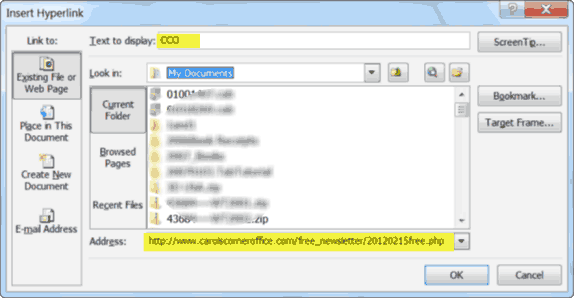
  3. In the Links group, select Hyperlink or simply highlight your text and click Ctrl + K which will open the Insert Hyperlink Dialog box.
Insert-Hyperlink-Dialog
  1. In the Text to Display area you will see the text you highlighted.
  2. At the bottom in the Address area, you will paste the URL.
That certainly looks better than a whole long URL doesn’t it

Tuesday, April 29, 2014

Guidelines on treatment of effect of penalties on promotion — role of Departmental Promotion Committee

Guidelines on treatment of effect of penalties on promotion — role of Departmental Promotion Committee

Written By Admin on April 28, 2014 | Monday, April 28, 2014

Guidelines on treatment of effect of penalties on promotion — role of Departmental Promotion Committee

No. 22011/4/2007-Estt. (D)
Government of India
Ministry of Personnel, Public Grievances & Pension
Department of Personnel & Training
North Block, New Delhi,
Dated the 28th April, 2014
OFFICE MEMORANDUM
Subject: Guidelines on treatment of effect of penalties on promotion — role of Departmental Promotion Committee
The Department of Personnel & Training had in its O.M. No.22011/5/86-Estt (D) dated 10.04.1989 issued consolidated instructions on Departmental Promotion Committee and matters related thereto. Para 6.2.3 of said O.M. provides that "before making the overall grading after considering the CRs for the relevant years, the DPC should take into account whether the officer has been awarded any major or minor penalty or whether any displeasure of any superior officer or authority has been conveyed to him as reflected in the ACRs." These guidelines further provide that "the DPC should not be guided merely by the overall grading, if any, that may be recorded in the ACRs (now APARs) but should also make its own assessment on the basis of entries in the CRs (now APARs) because it has been noticed that sometimes the overall grading in a ACR (now APAR) may be inconsistent with the grades under various parameters or attributes".

2. It further provides that an officer whose increments have been withheld or who has been reduced to a lower stage in the time scale, cannot be considered on that account to be ineligible for promotion to the higher grade as the specific penalty of withholding promotion has not been imposed on him/her. The suitability of the officer for promotion should be assessed by the DPC as and when occasions arise for such assessment. In assessing the suitability, the DPC will take into account the circumstances leading to the imposition of the penalty and decide whether in the light of the general service record of the officer and the fact of the imposition of the penalty he should be considered suitable for promotion. However, even where the DPC considers that despite the penalty, the officer is suitable for promotion, the officer should not be actually promoted during the currency of the penalty.

3. Further this Department's O.M. No. No.22034/5/2004-Estt (D) dated 15.12.2004 provides that a Government servant, on whom a minor penalty of withholding of increment etc. has been imposed, should be considered for promotion by the Departmental Promotion Committee which meets after the imposition of the said penalty and after due consideration of full facts leading to imposition of the penalty, if he is still considered fit for promotion, the promotion may be given effect after the expiry of the currency of the penalty.

4. The procedure and guidelines to be followed for promotion of Government servants against whom disciplinary/court proceedings are pending or whose conduct is under investigation has been laid down in this Department's O.M. No.22011/4/91-Estt(A) dated 14.9.92 and O.M. No.22034/4/2012-Estt (D) dated 02.11.2012 and 23.1.2014.

5. The role of Departmental Promotion Committee(DPC) in assessment of the officers being considered for promotion, including the officer(s) against whom a chargesheet has been issued or on whom a penalty has been imposed, has been examined by the Supreme Court in several judgments. The observations of Supreme Court in some of the important cases are summarized as under:

(a) In A.K. Narula case (AIR 2007 SC 2296), the Hon'ble Supreme Court has observed:
"the guidelines give a certain amount of play in the joints to the DPC by providing that it need not be guided by the overall grading recorded in the CRs, but may make its own assessment on the basis of the entries in the CRs. The DPC is required to make an overall assessment of the performance of each candidate separately, but by adopting the same standards, yardsticks and norms. It is only when the process of assessment is vitiated either on the ground of bias, malafide or arbitrariness, the selection calls for interference. Where the DPC has proceeded in a fair, impartial and reasonable manner, by applying the same yardstick and norms to all candidates and there is no arbitrariness in the process of assessment by the DPC, the court will not interfere".
(b) In Union of India vs. K.V. Jankiraman case(AIR 1991 SC 2010), the Supreme Court has taken cognizance of role of DPC the case of an officer on whom a penalty has been imposed and has held that:
"An employee has no right to promotion. He has only right to be considered for promotion. The promotion to a post and more so, to a selection post, depends upon several circumstances. To qualify for promotion, the least that is expected of an employee is to have an unblemished record. That is the minimum expected to ensure a clean and efficient administration and to protect the public interest. An employee found guilty of misconduct cannot be placed on par with the other employees, and his case has to be treated differently....... In fact, while considering an employee for promotion his whole record has to be taken into consideration and if a promotion committee takes the penalties imposed upon the employee into consideration and denies him the promotion, such denial is not illegal and unjustified."
(c) In UOI & Anr. Vs. S.K. Goel & Ors. (Appeal (Civil) 689/2007 -SLP(C)-2410/2007), the Hon'ble Supreme Court has held that:
"DPC enjoyed full discretion to devise its method and procedure for objective assessment of suitability and merit of the candidate being considered by it. Hence interference by High Court is not called for. "
While delivering the above judgement, the Division Bench has observed that:
"...it is now more or less well settled that the evaluation made by an Expert Committee should not be easily interfered with by the Court which do not have the necessary expertise to undertake the exercise that is necessary for such purpose."

6. It has been brought to the notice of this Department that DPCs have been adopting varying criteria in assessment of officials undergoing penalty that are not consistent with the extant instructions of the DOPT for e.g., downgradation of grading in ACR/APAR, denying promotion for specified number of years, etc.

7. The matter has been examined in consultation with the Department of Legal Affairs. It is a settled position that the DPC, within its power to make its own assessment, has to assess every proposal for promotion, on case to case basis. In assessing the suitability, the DPC is to take into account the circumstances leading to the imposition of the penalty and decide, whether in the light of general service record of the officer and the effect of imposition of penalty, he/she should be considered suitable for promotion and therefore, downgradation of APARs by one level in all such cases may not be legally sustainable. Following broad guidelines are laid down in respect of DPC:

a) DPCs enjoy full discretion to devise their own methods and procedures for objective assessment of the suitability of candidates who are to be considered by them, including those officers on whom penalty has been imposed as provided in DoPT O.M. dated 10.4.89 and O.M. dated 15.12.2004.

b) The DPC should not be guided merely by the overall grading, if any, that may be recorded in the ACRs/APARs but should make its own assessment on the basis of the entries in the ACRs/APARs as it has been noticed that sometimes the overall grading in a ACR/APAR may be inconsistent with the grading under various parameters or attributes. Before making the overall recommendation after considering the APARs (earlier ACRs) for the relevant years, the DPC should take into account whether the officer has been awarded any major or minor penalty.
(Refer para 6.2.1(e) and para 6.2.3 of DoPT OM dated 10.04.89)

c) In case, the disciplinary/criminal prosecution is in the preliminary stage and the officer is not yet covered under any of the three conditions mentioned in para 2 of DoPT O.M. dated 14.09.1992, the DPC will assess the suitability of the officer and if found fit, the officer will be promoted along with other officers. As provided in thisDepartment's O.M. dated 02.11.2012, the onus to ensure that only person with unblemished records are considered for promotion and disciplinary proceedings, if any, against any person coming in the zone of consideration are expedited, is that of the administrative Ministry/Department.

d) If the official under consideration is covered under any of the three condition mentioned in para 2 of O.M. dated 14.09.1992, the DPC will assess the suitability of Government servant along with other eligible candidates without taking into consideration the disciplinary case/criminal prosecution pending. The assessment of the DPC including 'unfit for promotion' and the grading awarded are kept in a sealed cover. (Para 2.1 of DoPT OM dated 14.9.92).

e) Para 7 of DoPT OM dated 14.09.92 provides that a Government servant, who is recommended for promotion by the DPC, but in whose case, any of the three circumstances on denial of vigilance clearance mentioned in para 2 of ibid O.M. arises after the recommendations of the DPC are received but before he/she is actually promoted, will be considered as if his/her case had been placed in a sealed cover by the DPC. He/she shall not be promoted until he/she is completely exonerated of the charges against him/her.

f) If any penalty is imposed on the Government servant as a result of the disciplinary proceedings or if he/she is found guilty in the criminal prosecution against him/her, the findings of the sealed cover/covers shall not be acted upon. His/her case for promotion may be considered by the next DPC in the normal course and having regard to the penalty imposed on him/her (para 3.1 of DoPT OM dated 14.9.92).

g) In assessing the suitability of the officer on whom a penalty has been imposed, the DPC will take into account the circumstances leading to the imposition of the penalty and decide whether in the light of general service record of the officer and the fact of imposition of penalty, the officer should be considered for promotion. The DPC, after due consideration, has authority to assess the officer as 'unfit' for promotion. However, where the DPC considers that despite the penalty the officer is suitable for promotion, the officer will be actually promoted only after the currency of the penalty is over (para 13 of DoPT OM dated 10.4.89).

h) Any proposal for promotion has to be assessed by the DPC, on case to case basis, and the practice of downgradation of APARs (earlier ACRs) by one level in all cases for one time, where a penalty has been imposed in a year included in the assessment matrix or till the date of DPC should be discontinued immediately, being legally non-sustainable.

i) While there is no illegality in denying promotion during the currency of the penalty, denying promotion in such cases after the period of penalty is over would be in violation of the provisions of Article 20 of the Constitution

j) The appointing authorities concerned should review comprehensively the cases of Government servants, whose suitability for promotion to a higher grade has been kept in a sealed cover on the expiry of 6 months from the date of convening the first Departmental Promotion Committee which had adjudged his suitability and kept its findings in the sealed cover. Such a review should be done subsequently also every six months. The review should, inter alia, cover the progress made in the disciplinary proceedings/criminal prosecution and the further measures to be taken to expedite the completion. (Para 4 of O.M. dated 14.09.1992)

k) In cases where the disciplinary case/criminal prosecution against the Government servant is not concluded even after the expiry of two years from the date of the meeting of the first DPC which kept its findings in respect of the Government servant in a sealed cover then subject to condition mentioned in Para 5 of this Department's O.M. dated 14.09.1992, the appointing authority may consider desirability of giving him ad-hoc promotion (Para 5 of this Department's O.M. dated 14.09.1992).

8. All the administrative authorities in the Ministries/Department are advised to place relevant records, including charge sheet, if any, issued to the officer concerned, penalty imposed, etc., before the DPC/ACC who will decide the suitability of officer for promotion keeping in view the general service records of the officer including the circumstances leading to the imposition of the charge sheet or penalty imposed. If such an officer is found suitable, promotion will be given effect after the currency of the penalty is over.

9. All Ministries/Departments are, therefore, requested to keep in view the above guidelines while convening DPC for promotion of the Government servants on whom either penalty has been imposed or where there are adverse remarks in the reckonable ACRs/APARs.

sd/-
(Mukta Goel)
Director

Source: www.persmin.nic.in
[http://ccis.nic.in/WriteReadData/CircularPortal/D2/D02est/22011_4_2007-Estt.D-28042014.pdf]

Via : http://karnmk.blogspot.in/